


The Road and the Ranch
February 28, 2026
Written By Adam Buckallew
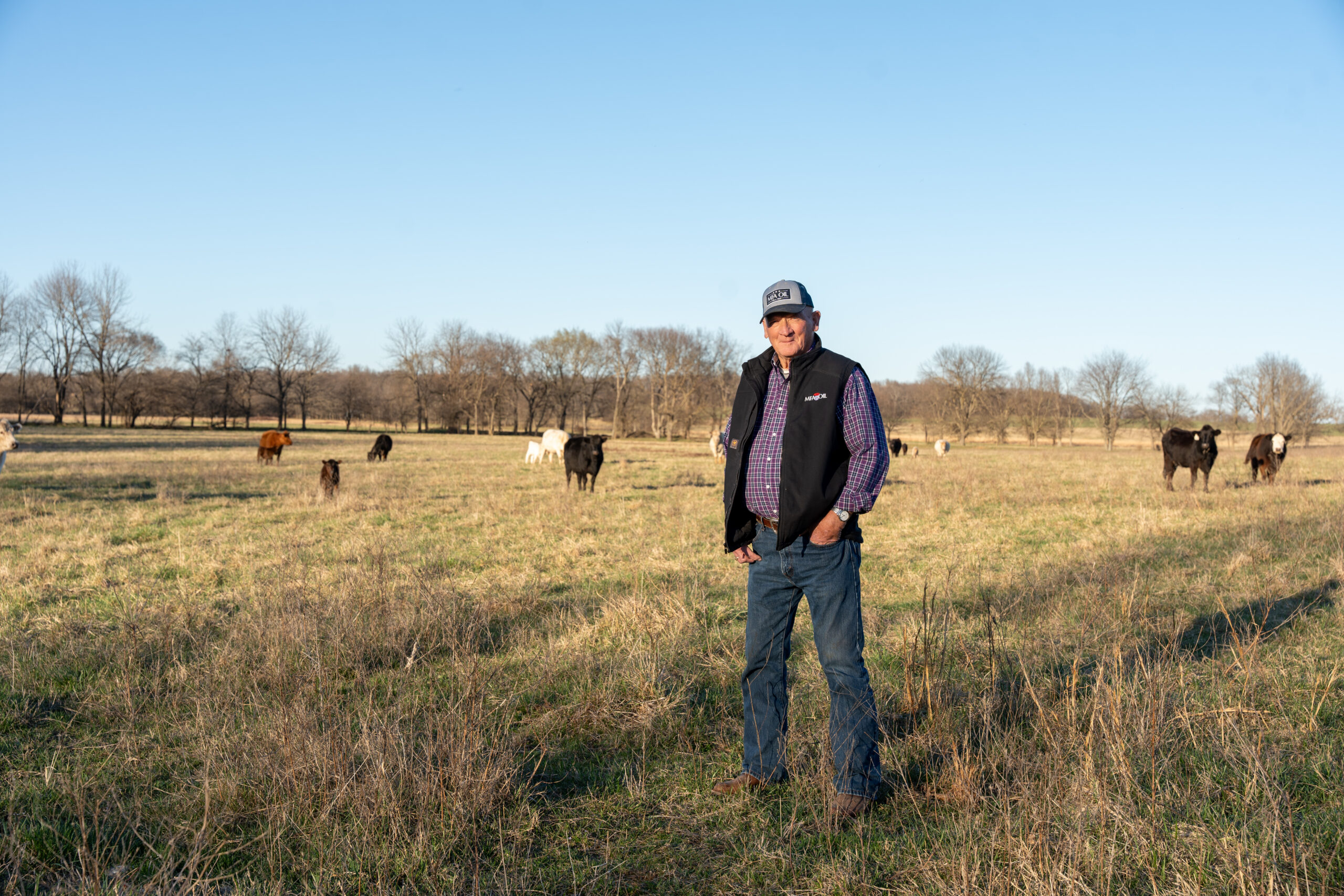
Larry Triplett has been around cattle since he was old enough to follow his grandfather through a pasture. That was a long time ago. In the decades since, he has built a career that took him around the world and figured out how to run a ranch almost single-handedly while holding down a travel-intensive corporate job. He’s nearly 80 now, with 200 cows and a system so efficient he hardly needs to ask for help. He’ll tell you that didn’t happen by accident.
The Sarcoxie, Mo., native spent 40 years with Leggett & Platt, rising through the ranks to become vice president of manufacturing before retiring in 2002. It was a career that took him to plants across the country in Kentucky, Indiana, Massachusetts, Florida and Alabama, with occasional trips to Europe and Mexico. He was on the road up to 40 weeks out of the year. But he never gave up the cattle.
“I’ve always had cattle since I was 20,” Triplett says. “Even when I was working and traveling, I kept a small herd.”
With so much time spent away from the farm, Triplett did what any good manufacturing man would do: He engineered a solution. Over the years, he designed his operation to run on as little labor as possible. His corrals are fitted with large hay feeders that hold four or five bales at a time. His weaning system requires little manpower, and his small feedlot allows him to move cattle off grass and back to the pasture again with minimal effort. The whole system, as he describes it, is built for efficiency without sacrificing results.
“My cattle are just as fat as anyone else’s,” he says with a laugh. “I just don’t go buying a bunch of fancy tubs and high-dollar inputs to get there.”
Today, Triplett operates 800 acres outside Sarcoxie with a mix of purebred Angus and Charolais crosses grazing on fescue, red clover and about 60 acres of Bermuda grass. He rotates pastures regularly and handles most of the work himself, calling on his sons when he needs an extra set of hands.
Building the operation took decades of patient thinking. Triplett began buying land in the 1970s and 80s, picking up farms at $317 to $500 an acre in an era when many people weren’t looking at ground as a long-term investment. He developed a straightforward business plan: When cattle prices were strong, he would sell and use the proceeds to buy more land. He would then rebuild his herd and repeat.
“I always disagreed with people who said a farm had to pay for itself right away,” he says. “I figured that if I could cover the interest and some of the principal, the land appreciation would handle the rest. I’ve found that to be true.”
For nearly 20 years, Triplett has served as a delegate for MFA Oil, a role he took on at the request of his local plant manager. He buys his diesel fuel, propane and lubricants through the co-op and values it for reasons that go beyond price.
“They’ve always taken care of my needs,” he says. “I’ve known many of the employees for so long that they are like family to me.”
Triplett has been a delegate long enough to know the co-op works best when more farmers choose to be part of the process.
“I’d tell any farmer around here to look into it,” he says. “The more people that use it, the stronger it gets for all of us.”
After 62 years of marriage to his wife, Judy, and decades of splitting his time between the road and the ranch, Triplett has ended up exactly where he wants to be. The land is paid for, the herd is healthy, and cattle prices are at or near historic highs.
“The beef business has never been better,” he says. “If you’ve been able to stick with it, it’s been great.”
Photo by Katelyn Rogers