


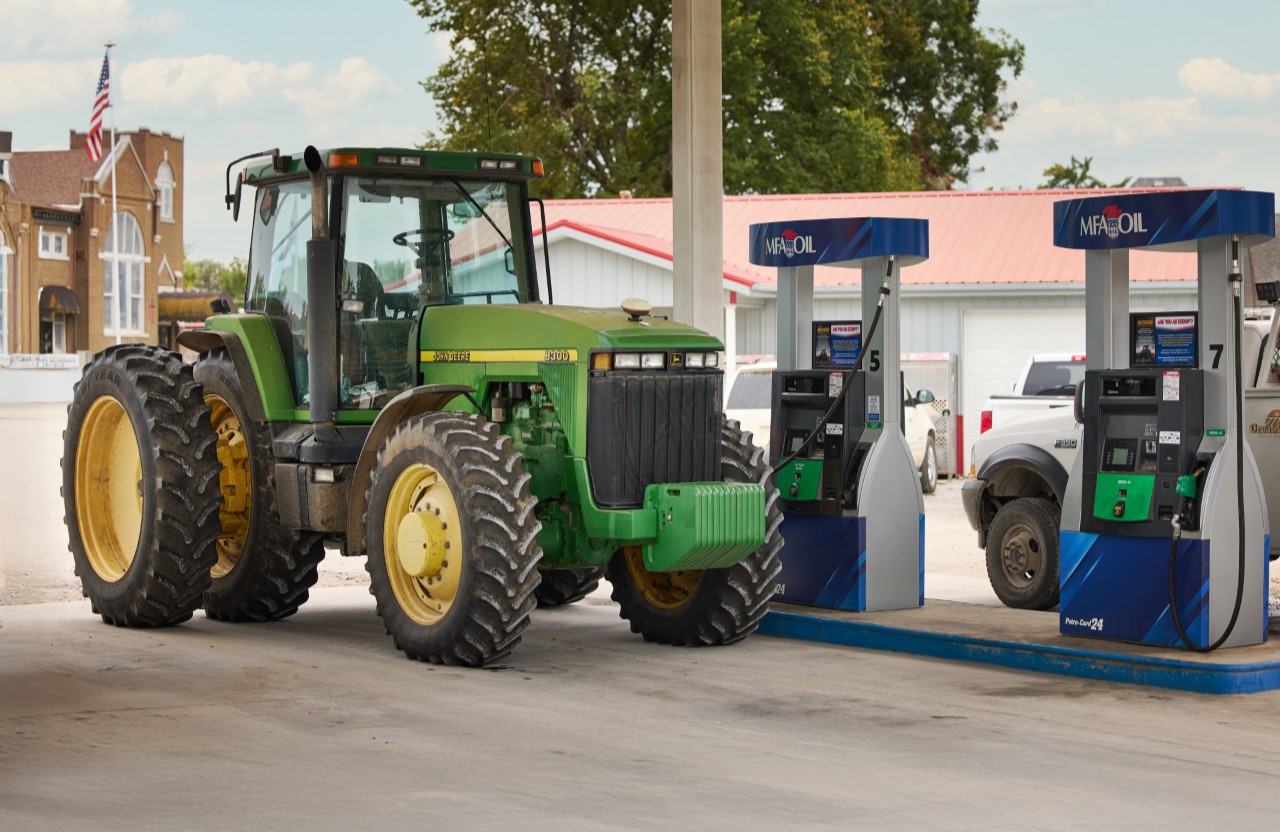
Farm Fuel Hits the Highway
November 17, 2026
Written By Adam Buckallew
With the federal government temporarily easing certain penalties for dyed diesel used on public highways, farmers have questions about what the changes mean for their operations. The rules are more complicated than they might seem at first glance. Importantly, federal relief does not automatically eliminate state restrictions, and requirements vary depending on where you operate.
Here’s what farmers and other MFA Oil customers should know about the temporary changes, agricultural tax exemptions and the steps to take before changing their fueling practices.
What has the federal government changed?
On Oct. 5, President Donald Trump signed an executive order titled “Emergency Tax Relief on Diesel Fuel” in response to elevated diesel prices. The order directed the U.S. Department of the Treasury to provide conditional federal excise tax deferral and specified penalty relief for highway sales and use of dyed diesel.
On Oct. 14, the Internal Revenue Service (IRS) announced a temporary federal penalty relief for dyed diesel sold for highway use or used in diesel-powered highway vehicles nationwide. The relief applies retroactively to Oct. 1, 2026, and runs through Dec. 31, 2026.
The IRS has also granted temporary relief from certain federal reporting and recordkeeping requirements. Taxpayers generally won’t have to file or amend federal excise tax returns solely to report covered dyed diesel use during the relief period or reconstruct records afterward. Other tax reporting obligations and records required for independent tax purposes or exemption claims still apply.
However, the executive order only applies to federal requirements and doesn’t eliminate state taxes, penalties or restrictions that apply to dyed diesel use. It’s also important to remember that the order did not eliminate the federal diesel tax; it simply postponed payment to Jan. 1, 2027.
The IRS is still considering whether to provide a grace period for dyed fuel remaining in vehicle tanks after the relief period ends. Additional guidance is expected to be released.
What are states in the MFA Oil trade territory doing?
State rules differ, and temporary measures may cover only certain vehicles, activities or roads. The following is a working summary of the information available as of Oct. 29, 2026.
| State | Temporary highway-use measures | Agricultural sales tax exemption documentation |
| Missouri | Broad temporary relief through Dec. 31, 2026 | Missouri Department of Transportation Form 149 |
| Oklahoma | Temporary relief for farm vehicles through Jan. 26, 2027 | Active Oklahoma Agricultural Exemption Permit |
| Arkansas | Temporary relief for qualifying agricultural and forestry operations through Dec. 31, 2026 | No specific exemption form or card required for dyed diesel purchases |
| Kansas | None | Kansas Agricultural Exemption Certificiate |
| Iowa | Certain state penalties suspended through Feb. 2, 2027, for qualifying agricultural transportation | Iowa Sales/Use/Excise Tax Exemption Certificate |
Important: Agricultural sales tax exemptions and permission to use dyed diesel on public highways are separate matters. An agricultural exemption certificate does not, by itself, authorize highway use.
What does this mean for farmers?
The temporary federal relief may provide additional flexibility for farmers who need to move equipment or conduct other qualifying activities on public roads. However, it does not mean every vehicle, trip or use of dyed diesel is automatically permitted.
Before using dyed diesel on a public road, check current federal and state requirements for your vehicle, activity and travel route. Pay particular attention to state rules if your work takes you across state lines.
Additionally, farmers should consider the potential for residual dye to linger in vehicle fuel tanks and fuel filters after the relief period expires. Under normal circumstances, using dyed diesel in a highway vehicle can result in federal and state taxes, penalties and other enforcement actions.
The IRS penalty for unauthorized dyed diesel use is a fine of $1,000 or $10 per gallon, whichever is more expensive. Many states impose their own matching or stacking penalties, back taxes, vehicle impoundments or commercial driver’s license (CDL) consequences.
How to claim agricultural tax exemptions on MFA Oil purchases
Farmers who qualify for agricultural sales tax exemptions should provide MFA Oil with the documentation required in their state so the appropriate exemption can be applied to their account.
For qualifying bulk fuel deliveries, applicable exemptions can be applied when the necessary documentation is on file. At Petro-Card 24 locations, use a Petro-Card 24 fuel card so eligible purchases can be identified and applicable state or local sales tax exemptions applied.
If you need help with exemption documentation or your account, contact your local MFA Oil office for assistance.
Petro-Card 24 purchase limit increases
In response to the rise in diesel prices, MFA Oil has temporarily increased the single-purchase limit at Petro-Card 24 locations from $999 to $2,000.
Stay informed
While the federal government has temporarily eased certain penalties and reporting requirements for dyed diesel, state restrictions and other tax obligations may still apply. Because the rules and relief periods can change, farmers should verify current requirements before making fueling decisions. For questions about whether a specific vehicle or trip qualifies for highway-use relief, consult the appropriate state agency or a qualified tax professional.
Regulations and relief periods are subject to change. This article summarizes information available as of Oct. 29, 2026, and is not tax or legal advice.